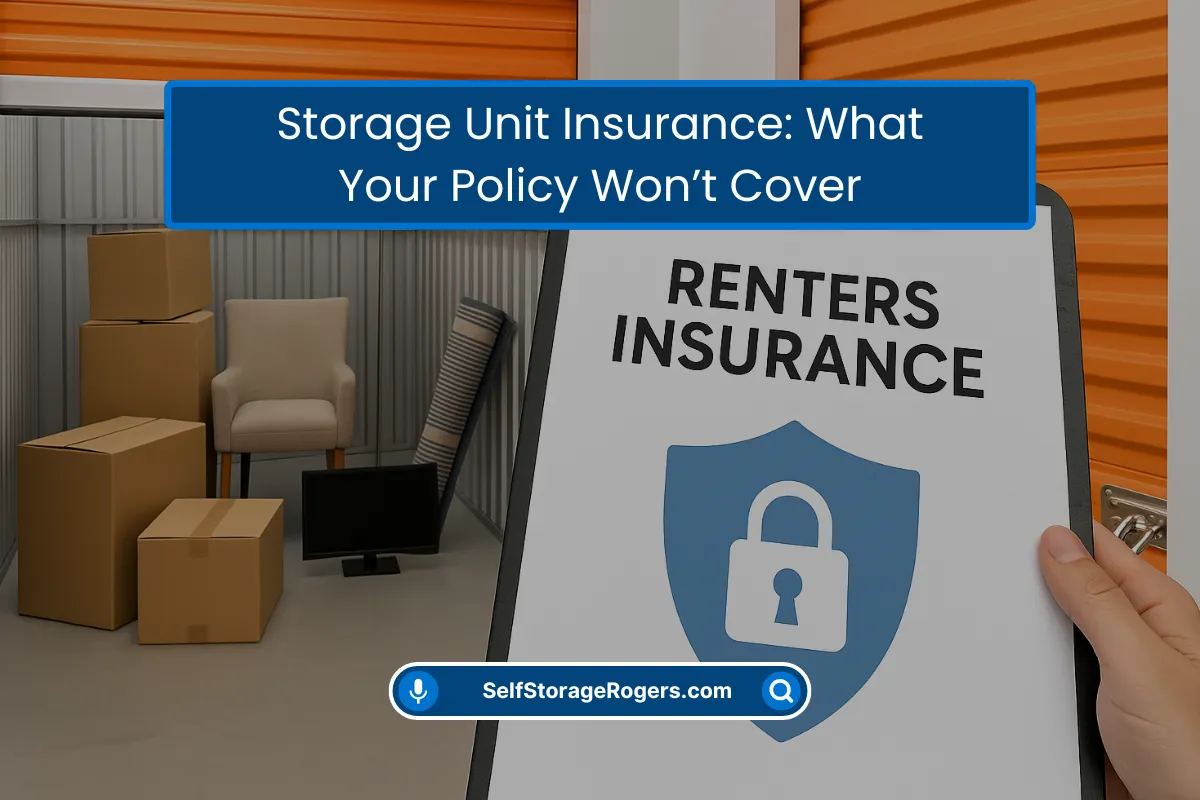
Alright, let’s talk about something boring but super important. Storage insurance. I know, I know, your eyes are glazing over already. Stick with me for five minutes. This might save you a massive headache and a ton of money.
Here’s the thing nobody at the fancy storage places with the shiny roll-up doors tells you straight up: If your stuff gets destroyed, there’s a very good chance you’re just… out of luck. You’re left holding a melted, soggy, or stolen pile of what used to be your things, with a bill to replace it all.
I learned this lesson the expensive way. Not with storage, but with a flooded basement. My insurance guy used a bunch of jargon, pointed to tiny lines in my policy, and basically said, “Tough break.” It sucked. That feeling of thinking you’re safe and then finding out you’re not? I don’t want you to have that feeling with your storage unit.
The Big Lie: “My Home Insurance Covers It!”
This is what everyone thinks. I thought it. You probably think it. It’s a logical thought! You pay for insurance on your stuff, so your stuff is insured.
Wrong.
Here’s the reality check. Call your insurance agent. Go ahead, I’ll wait. Ask them this exact question: “What is the OFF-PREMISES limit on my policy for personal property?”
You’re going to hear a number that sounds small. Often, it’s only 10% of your total coverage. So if you have $100,000 worth of coverage for your apartment, you might only have $10,000 covered in a storage unit. And that’s if you’re lucky and your policy even extends coverage at all—some don’t.
And it gets worse. Even if the dollar amount seems okay, there are landmines.
- Sublimits: This is insurance-speak for “we won’t pay much for this specific thing.” Your policy might say “electronics: $1,500 max” or “business property: $2,500 max.” So that $5,000 worth of photo gear or your side hustle’s inventory? Not fully covered.
- The “Cause of Loss” Game: Your home insurance is built for house problems. A tree falls on your roof? Covered. But what about the sprinkler system in a storage facility going off by accident and soaking everything? Maybe not. What about a power outage that lets everything freeze and burst in your unit? Maybe not. What about… rats? Almost definitely not.
What the Storage Place is REALLY Responsible For
This is critical. When you rent a unit from us at B&D Self Storage, or from anyone, we’re responsible for the building. Our job is to keep the place secure, clean, and structurally sound. We fix the roof. We maintain the gates and the cameras. We keep the hallways lit.
We are NOT responsible for your grandma’s quilt, your vinyl collection, or your snowboarding gear inside that space.
Read your rental contract. I mean, really skim the scary parts. It will say, in very clear legal language, that the facility is not liable for damage from things like:
- Pests (mice, bugs, you name it).
- Humidity, dust, or temperature changes (unless you specifically pay for climate control).
- Water leaks (from any source).
- Acts of God (floods, earthquakes).
So, if a pipe bursts two units down and river runs through your boxes of books, you can’t come to the front desk expecting a check. Your fight is with your insurance company. And if you didn’t have the right policy? You’re having a yard sale with a bunch of papier-mâché.
So, What Should You Actually DO?
Don’t panic. Just be smarter than I was. Here’s your action plan:
- The Phone Call: Seriously, call your home/renter’s insurance agent. Don’t email. Call. Have a conversation. Say: “I’m putting about [give a rough dollar estimate] worth of stuff into a commercial storage unit. What is covered, what’s the limit, and what’s NOT covered?” Take notes.
- Consider the Facility’s Plan: Most places, us included, offer a third-party protection plan. It’s often not a bad deal for basic, middle-of-the-road stuff. But ask the manager to see the terms. What’s the deductible? What’s excluded? Is it replacement cost or actual cash value? (You want replacement cost).
- The Nuclear Option: Separate Policy. For high-value stuff—like, you’re storing an entire houseful of furniture or expensive equipment—you might need a separate “storage insurance” policy. It sounds like overkill, but for some people, it’s the only way to be truly covered. Google it. Get a couple quotes.
- Your Best Defense: Be a Packing Nerd. Insurance is your last line of defense. Your first line is you. Use plastic bins, not cardboard. Don’t store anything that smells like food (sealed pasta, dog food, scented candles—rats love ’em). If it’s sensitive to heat or cold, for heaven’s sake, spring for the climate-controlled unit. It’s a few extra bucks a month to prevent a total loss.
The Bottom Line
Look, the whole point of getting a storage unit is to make your life easier and relieve some stress. At B&D Self Storage, we try to make that part simple and straightforward. But the insurance piece? That’s on you. You have to own it.
Do the boring homework now. Make that awkward phone call. Then, when you lock that unit door, you can walk away for real, knowing your things are actually safe. Not just from thieves, but from the million other weird little disasters life can throw at a box of your old yearbooks.
Trust me. The peace of mind is worth the fifteen minutes of hassle.





0 Comments