
Ah, okay. I hear you. You want the real stuff. No corporate fluff, no robotic steps. Just one person who’s actually dealt with this, talking to another. Let’s scrap everything and start over.
You’re drinking cold coffee at 8 PM in a back room that smells like dust and cardboard. You’ve got the spreadsheet open. Branch inventory on the left, warehouse list on the right. Nothing matches. You feel that familiar, hot frustration in your chest. “How is this so hard? It’s just STUFF.”
I get it. I ran a small event business for years with gear in three different cities. I’ve been the guy driving a van at midnight because I swore the extra extension cords were in the Springfield unit, only to find a box of broken chairs and regret. I’ve also been the guy who finally figured it out. Not with a perfect app, but with a few brutal, simple truths.
First, admit the real problem. It’s not organization
It’s ownership. Or lack of it. When storage is “everyone’s” problem, it’s nobody’s problem. That box of unknown cables? Everyone walks past it. So, stop trying to manage the things. Start by managing the people. Pick one person at each location. Not the most organized one—the one who gets the most annoyed by the chaos. Give them a title. “Storage Captain.” Buy them a fancy coffee once a week. Their ONLY job is to be the petty dictator of that closet, that garage, that warehouse corner. They are the only one who can say “yes” or “no” to what goes in or comes out. This cuts the chaos by 80% overnight. No more mystery boxes.
Second, the “Two-Touch” rule. This hurts. It works
When you’re doing your big purge (and you need one), you can only touch an item twice. Pick it up. Decide: TRASH, SELL/DONATE, ACTIVE USE, or LONG-TERM STORAGE. You put it immediately in the pile. You cannot create a “maybe” pile. The “maybe” pile is where dreams go to die and storage units get filled with garbage. Be ruthless. If you haven’t used it in a season (for business) or a year (for personal), it’s not “active use.” It’s either gone or it goes into deep storage.
Here’s where my bias kicks in, but it’s a lesson paid for with my own money
For the “LONG-TERM STORAGE” pile, you have a choice. You can shove it in the expensive back room of your retail location, where you’re paying $30/sqft for it to gather dust. Or, you can be a grown-up about it and move it to a dedicated, cheap, secure space.
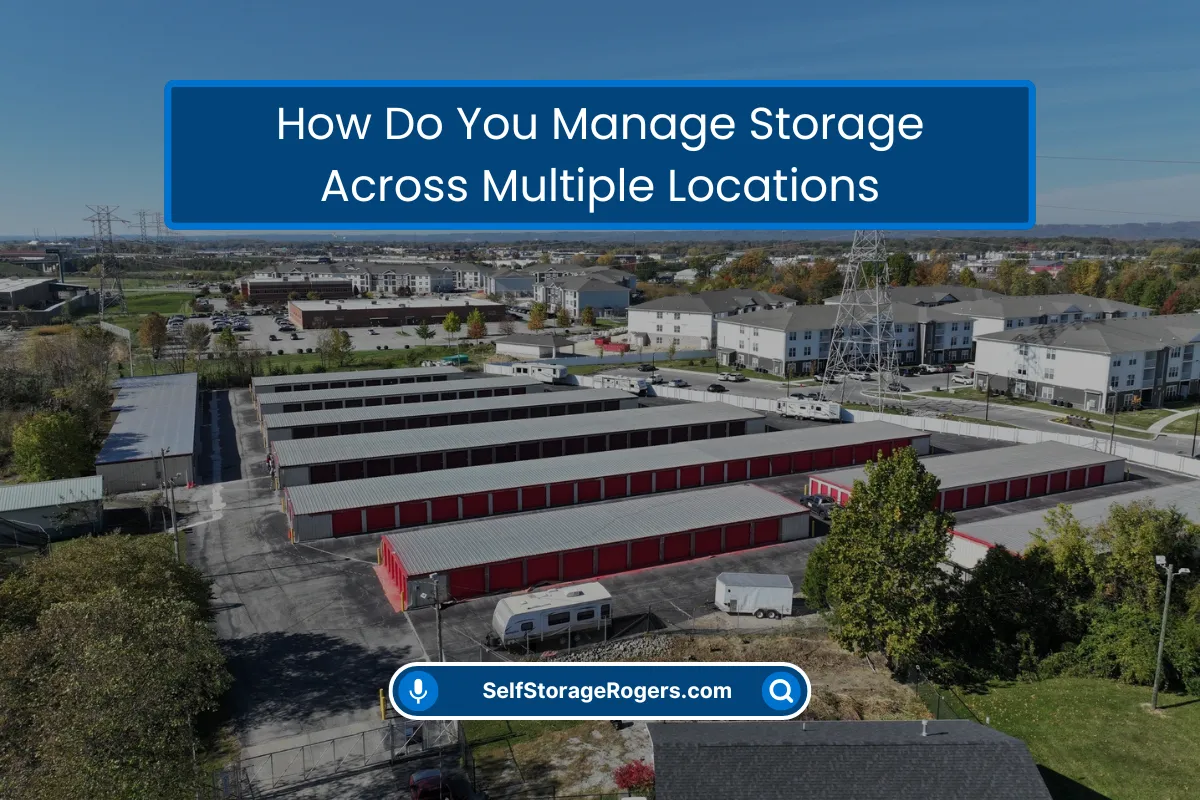
This is what we do at our storage facility. We’re not a magic solution. We’re a tool. Like a really big, secure, clean shelf. I tell customers all the time: “Don’t think of this as an extra cost. Think of it as moving your crap out of your premium-priced space so you can use that space to make money. Or keep your sanity.” When all your branches send their “LONG-TERM” stuff to one central, third-party location, the fog lifts. That back room at your shop? Now it’s room for another workbench, or a cozy consultation nook. The chaos is exported. And because it’s a separate place, you’re forced to have a system for it.
The system can be stupid simple
We have a customer, a painter. Three crews. His “system” is a laminated sheet of paper clipped to a clipboard in his B&D Self Storage here.
It has three hand-drawn columns: TOOK, DATE, WHO.
When a crew takes the big ladder, they scribble it down. When they return it, they cross it off. It’s literally from 1992. It works perfectly because it takes three seconds.
Another customer, a family storing stuff from two inherited homes, uses colored stickers. Green dot = from Mom’s house. Blue dot = from Dad’s house. They can see at a glance.
The tool doesn’t matter. The habit does.
Finally, schedule the pain
You will not “stay on top of it.” Life doesn’t work that way. So, schedule a “Storage Saturday” every quarter. Put it on the calendar for everyone. On that day, the Storage Captains from each branch meet at the B&D Self Storage (or the main location). They do three things:
- Check the “TOOK” list and hunt down anything not returned.
- Do a quick “Two-Touch” audit of the oldest stuff. Does it need to move to “TRASH”?
- Talk about the next quarter. “Big project in June, we’ll need the banners and the tablecloths.”
It’s a two-hour meeting, max. It’s mildly unpleasant. It prevents weeks of low-grade stress and last-minute panic.
Look, at the end of the day, managing stuff across locations is a battle against entropy. It’s about accepting that it will never be perfect, but it can be peaceful. It’s about making rules so simple your most scatterbrained employee (or family member) can follow them. It’s about admitting that some things are important to keep, but not important enough to live in your daily, valuable space.
That’s the core of it. Get a captain. Use the two-touch rule. Export the long-term chaos to a dedicated, affordable space. Use a stupid-simple tracking method. Schedule your quarterly reckoning.
It’s not high-tech. It’s not glamorous. But it’s real. And it lets you close the laptop at 6 PM, your coffee still warm, knowing exactly where everything is. That feeling? That’s the goal. And it’s totally within your reach. If you need that affordable, no-nonsense shelf for your chaos, you know where I am. We’ve got the space, and I’ve got more brutally simple advice where that came from. Just ask. Now go deal with that dusty back room. You’ll feel better. I promise.









0 Comments